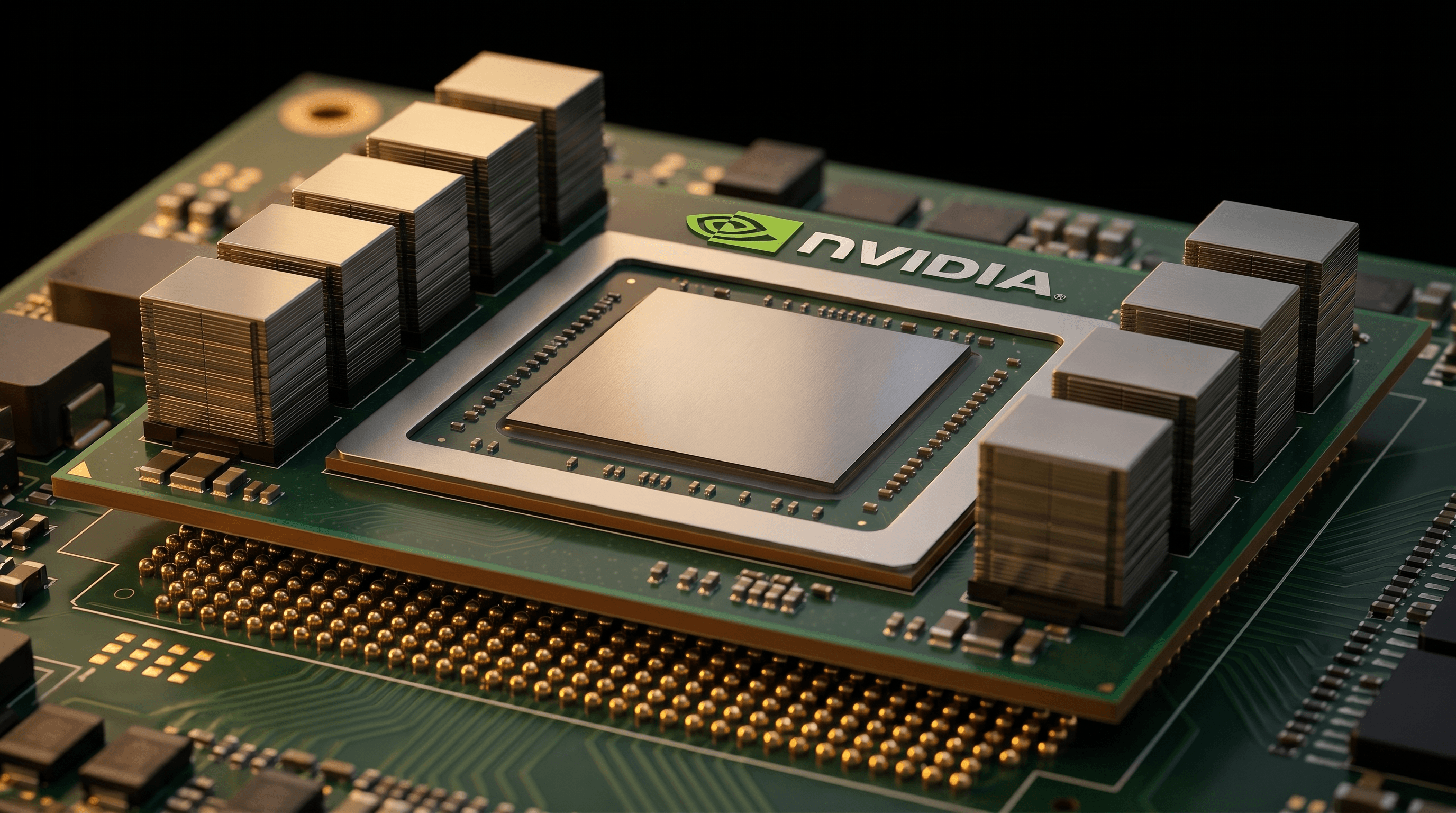
Nvidia's CEO said four words at Computex Taipei — "the next trillion-dollar company" — and Marvell Technology (MRVL) jumped roughly 33% in a single session, its biggest one-day move in history. Custom AI silicon just stopped being a footnote.
What actually happened to Marvell?
Marvell rose about 33% on June 2, 2026, after Nvidia chief Jensen Huang singled it out at Computex Taipei. He called Marvell a future trillion-dollar company and paired the words with a reported ~$2 billion Nvidia investment plus tighter NVLink Fusion integration.
That combination matters more than the soundbite. An endorsement from the company that defines AI compute reframed Marvell from a component supplier into a strategic partner inside Nvidia's own ecosystem. Markets repriced the stock within minutes.
The move was Marvell's biggest single-day jump in its history, narrowly topping a 2023 spike. For a company worth roughly $250 billion before the pop, a one-third gain is an extraordinary repricing of future cash flows.
Why does custom silicon matter now?
Because the biggest AI buyers no longer want only off-the-shelf chips. Custom silicon — application-specific integrated circuits, or ASICs — are designed for one customer and one workload, trading flexibility for lower power and cost at massive scale.
Amazon (AMZN), Alphabet (GOOGL), Microsoft (MSFT) and Meta Platforms (META) all run AI workloads so large that shaving even a few watts per inference saves hundreds of millions of dollars a year. That is the entire economic case for ASICs.
Industry estimates put custom ASIC growth at roughly 45% in 2026, faster than the general-purpose GPU market. Marvell expects its own custom-chip revenue to clear approximately $10 billion by fiscal 2029, up from a run rate near $1.5 billion in fiscal 2026.
There is a strategic motive too. Building your own chip gives a hyperscaler control over supply, cost and differentiation — it stops being a price-taker at the mercy of a single dominant vendor. For companies spending tens of billions of dollars a year on compute, even partial independence is worth the engineering cost.
The shift is not that GPUs are losing — it is that a second, parallel chip market is being born underneath them. Understanding that distinction is the whole game.
Who wins the custom-chip race?
The answer is a short list. Designing a leading-edge ASIC requires intellectual property, advanced packaging know-how and a relationship with Taiwan Semiconductor (TSM), which fabricates almost every cutting-edge chip on earth.
| Company |
Role in custom AI silicon |
Why it matters |
| Marvell (MRVL) |
Co-designs ASICs for hyperscalers |
Custom run rate ~$1.5B, targeting ~$10B by FY2029 |
| Broadcom (AVGO) |
Largest merchant custom-ASIC designer |
Powers multiple in-house hyperscaler chips |
| Nvidia (NVDA) |
GPU leader now integrating partners |
NVLink Fusion opens its ecosystem to ASICs |
| Advanced Micro Devices (AMD) |
GPU challenger, MI-series accelerators |
Competes on open software and price |
| Microchip Technology (MCHP) |
Embedded + data-center silicon |
Data-center unit growing off a small base |
Broadcom (AVGO) remains the heavyweight here — it has quietly designed custom accelerators for several hyperscalers for years. Marvell (MRVL) is the higher-beta way to play the same theme, which is exactly why it moved so violently.
The supporting cast matters as well. Advanced Micro Devices (AMD) competes on open software and aggressive pricing, while Microchip Technology (MCHP) is leveraging a smaller data-center unit into the same demand wave. Neither is a pure custom-silicon bet, but both ride the broader buildout.
Is Nvidia threatened by its own customers?
Not yet — and arguably not for years. Nvidia (NVDA) still owns the training market, the software moat in CUDA, and the networking stack that ties AI clusters together. Custom chips mostly attack inference, the cheaper and more repetitive half of the workload.
But the threat is real at the margin. Every dollar a hyperscaler spends on an AVGO or MRVL ASIC is a dollar it does not spend on an NVDA GPU. Huang's decision to embrace partners through NVLink Fusion looks less like generosity and more like a strategy to stay at the center of every AI rack, even the ones full of someone else's chips.
Nvidia would rather take a smaller slice of a bigger, more open market than defend a shrinking walled garden. That is the quiet message inside the Marvell endorsement.
What is the risk to the custom-silicon thesis?
The risk is that custom chips can be a worse business than GPUs. ASIC contracts are customer-concentrated — lose one hyperscaler and a revenue line vanishes — and gross margins typically sit well below the roughly 70%-plus margins NVDA commands.
There is also a cyclicality problem. AI capex is booming now, but if hyperscaler spending normalizes, the suppliers with the least pricing power feel it first. Critics argue that today's ~45% growth rate simply cannot persist, and that investors are paying GPU-like multiples for lower-quality earnings.
Valuation is the other caveat. After a one-third jump, MRVL prices in years of flawless execution. Any guidance wobble could unwind the move as quickly as it happened.
What should investors watch next?
Watch three things. First, custom-chip revenue disclosures — Marvell and AVGO breaking out ASIC run rates is the clearest evidence the market is real. Second, hyperscaler capex guidance from AMZN, GOOGL, MSFT and META. Third, gross-margin trends, which reveal whether custom silicon is a great business or merely a big one.
If you want to pressure-test any of these names, start with the fundamentals rather than the headline. Our guide to fundamental analysis walks through the margin and cash-flow signals that separate durable franchises from cyclical pops, and you can browse more market commentary on the blog.
Ready to analyze these stocks yourself? Search any ticker on MainRatios to see valuations from 6 legendary investors - free.